|
Society News
1
2
3
4 5
6 |
|
Share this page with your friends |
|
|
www.blacktiemagazine.com
Towers of Light - 25th Anniversary
|
 |
|
Dr. Judy Kuriansky |
|
Black Tie International Magazine,:
Towers of Light 25th Anniversary |
|
|
"Towers of
Light":
A Healing and Hope Anthem for 9/11 and Beyond
By Dr. Judy Kuriansky |
|
|
 |
|
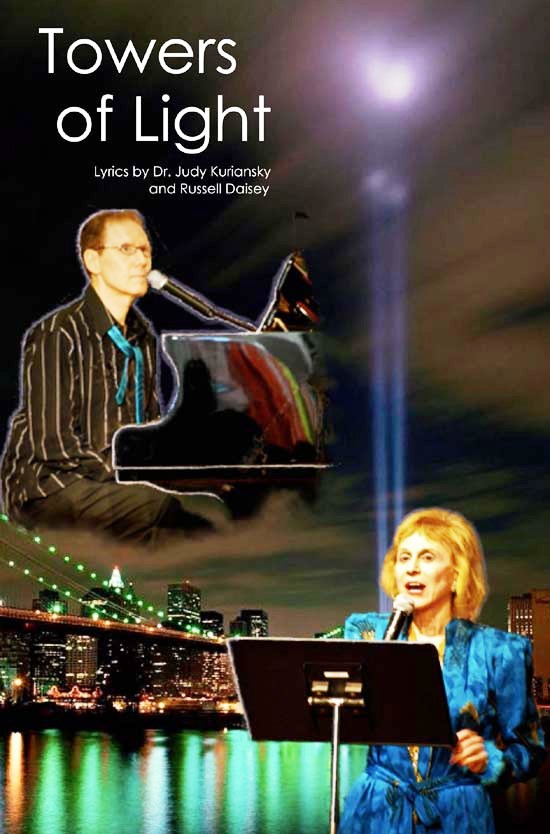
Original CD cover
of "Towers of Light" song |
|
|
On the 25th
anniversary of September 11, as a psychologist, first
responder, and musician, I am moved to reflect on the anthem
I created about that tragic event with composer and best
friend Russell Daisey - and its extraordinary journey from
Ground Zero to stages around the world.
The Healing Power of Music
I know from research, clinical work, and life
that a meaningful song can offer comfort, give voice to
emotion, and help restore hope after tragedy.
Few events in our recent history have been as
tragic as the attacks of September 11, 2001, when hijacked
planes struck the World Trade Center twin towers and the
Pentagon, while a fourth crashed in a field near Shanksville,
Pennsylvania. Like the assassination of President John F.
Kennedy, 9/11 became a "marker"
in our collective memory: a moment so
profound that people remember where they were when the world
changed.
The 25th anniversary on September 11, 2026 carries
particular meaning for me. In the immediate aftermath and
for months afterward, I served as a Red Cross mental-health
responder at Ground Zero and later at the Family Assistance
Center, providing psychosocial support to police officers,
firefighters, electricians, other responders, survivors, and
families.
This article chronicles the journey of the
anthem Russell and I wrote, called "Towers of Light" created to honor those who perished, salute
the heroes who answered the call, and offer solace to those
left behind.
When we completed the song in 2002, neither of us could have
imagined how far it would travel—or how many hearts and
souls it would touch.
The Beginning of the Song
On March 11, 2002, six months after the Twin Towers that had
defined the Manhattan skyline vanished, leaving the city's
skies eerily empty, two brilliant beams appeared where the
towers had previously stood |
|
|
 |
|
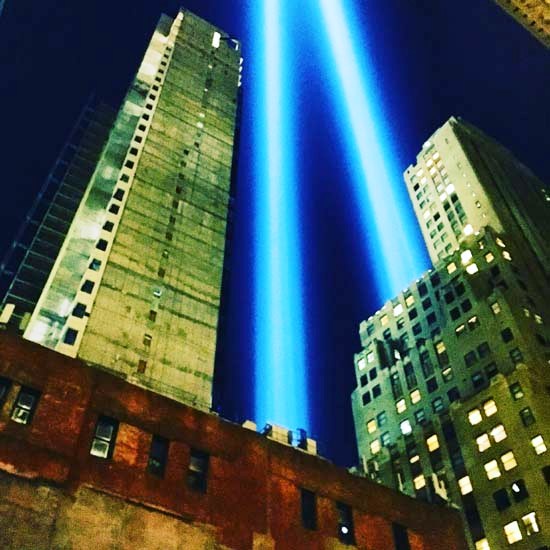
Russell’s
pursuit of viewing the "Tribute
in Light"
at memorials; this one in downtown New York
City on 9/11 in 2019 (photo: Russell Daisey) |
|
|
|
Conceived by a team of artists and architects initially as a
short-term public-art installation to shore up spirits
during the recovery work at Ground Zero, the "Tribute
in Light"
used 88 searchlights to create twin columns
visible for miles on a clear night. The beams had such an
emotional impact on people that they became an annual
tradition.
The attacks had affected every dimension of people's
lives. Couples argued about whether to communicate about
their fears, or whether to bring children into this troubled
world. Children suffered from nightmares and school phobia.
People searched desperately for meaning amid
incomprehensible loss, and questioned their faith.
That same year, I was teaching a course on
relationships at Teachers College, Columbia University. For
their final project, I gave my students an assignment that
felt especially urgent: create something that could help New
York City, the nation, and the world heal from the attacks.
Russell, then a master's
student in music education who took my course because I was
a well-known media psychologist on radio and TV, decided to
do his final project as a song. The choice was natural: he
was already an internationally acclaimed composer, pianist,
and singer-songwriter who had performed for audiences
worldwide and for presidents, prime ministers, dignitaries,
and public figures-including Presidents Bill Clinton and
George H. W. Bush, former Canadian Prime Minister Brian
Mulroney, and Nobel laureate and Holocaust survivor Elie
Wiesel.
Each night, he had looked wistfully downtown
toward the beams illuminating the place where the towers had
stood.
Wanting the lyrics to be psychologically meaningful, Russell
invited me to contribute to the words. Over five weeks, we
worked together on language that acknowledged trauma while
encouraging remembrance, resilience, connection, and hope. |
|
|
 |
|
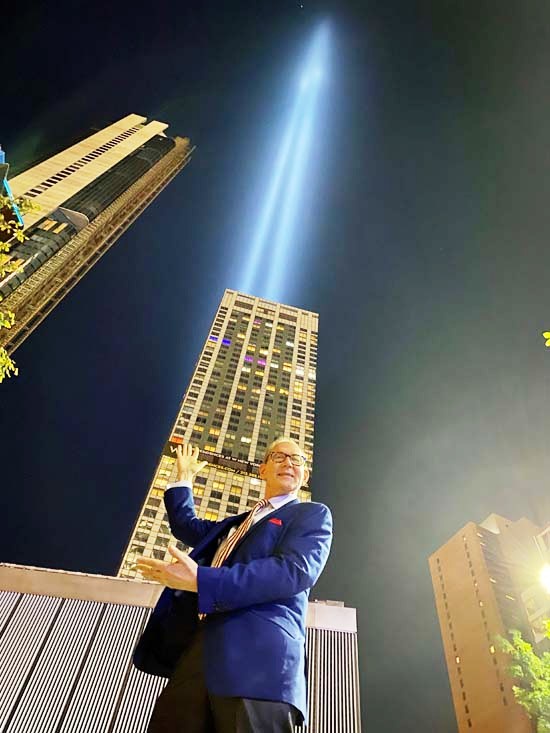
Russell Daisey standing in front of the
Tribute in Light memorial on 9/11 in 2021 (photo: Judy
Kuriansky) |
|
|
|
We wanted the song to honor the dead as well as the living
without referring specifically to 9/11 so that its message
could speak to people enduring any tragedy.
By the end of the summer semester of my course in late July
2002, we knew we had created something meaningful.
In the years since,
"Towers
of Light"
has been performed on five continents in
countless settings, touching the hearts of adults and
children around the world. |
|
|
 |
|
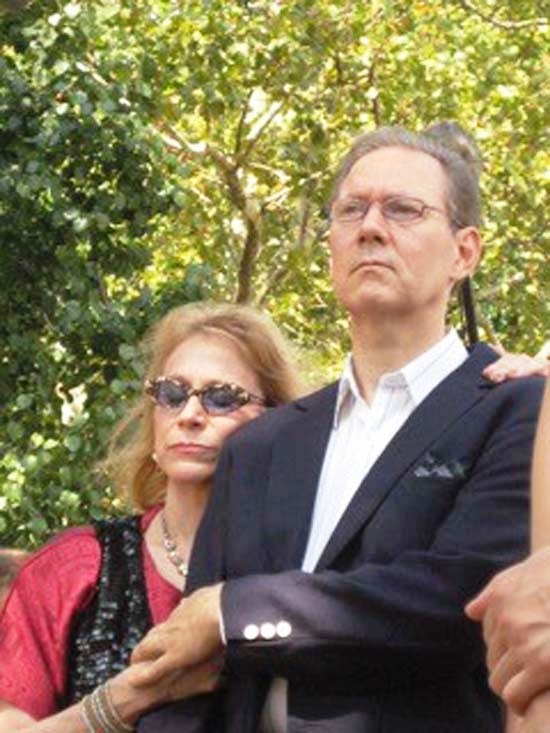
Dr. Judy Kuriansky and Russell Daisey at a
concert at the Triangle Park Memorial in downtown New York
City on 9/11/2008 |
|
|
Lyrics include:
They told us to get back to normal, But normal's so far
from my mind.
I’m looking for some kind of closure…to leave all this
sadness behind.
But right now let's honor the heroes…who sacrificed all for
our lives.
There must be a far greater purpose…where love over hatred
survives.
|
|
|
|
A Songwriting Team Emerges
Over the years, Russell and I became a songwriting and
performing team, and best friends. Together, we created
numerous anthems connected to global concerns and
initiatives of the United Nations, where I represented the
International Association of Applied Psychology and the
World Council for Psychotherapy. Our songs have been
presented at peace summits, world congresses, conferences,
religious services, and interfaith memorials around the
world. |
|
|
 |
|
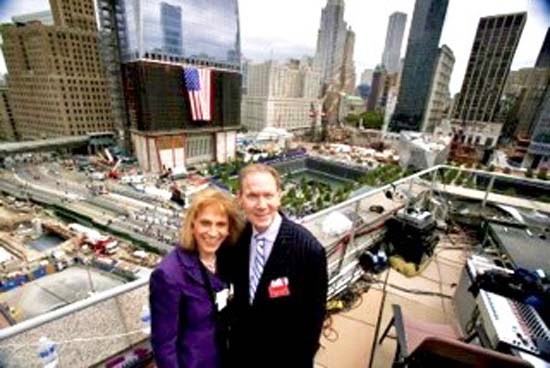
Dr. Judy Kuriansky and Russell Daisey on the
press terrace of the World Financial Center overlooking the
newly opened 9/11 Memorial Reflecting Pool, on 9/11/2011,
following Dr. Judy’s
interview with Alhurra TV News
(photo: Todd Connor) |
|
|
|
Our
anthems address mental health and well-being, the
empowerment of women and girls, disaster recovery, peace,
and interfaith harmony. Among them are "Stand
Up for Peace,"
"Every
Woman Every Child,"
"Happy
People, Happy Planet,"
"Hope
Is Alive,"
"One
in Faith,"
and "Hands
Off Our Girls."
The First Anniversary
On the morning of the first anniversary, I
traveled to Ground Zero for the memorial observance, which
included the now-traditional reading of the victims’
names and moments of silence, and ringing
bells at 8:46 a.m. and 9:03 a.m., when two planes struck the
towers. Along the route, I spoke with families showing
photographs of loved ones, and with police officers standing
watch. |
|
|
 |
|
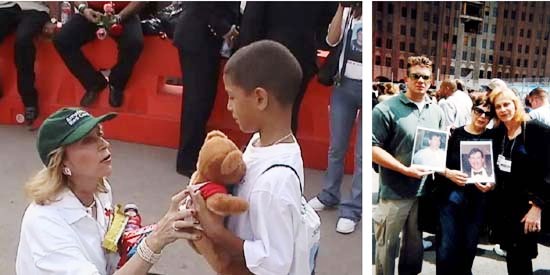
At the memorial celebration at Ground Zero on
the first anniversary of 9/11 in 2002: Dr. Judy handing out
a comfort bear to a child and with a family showing a photo
of their lost loved one |
|
|
|
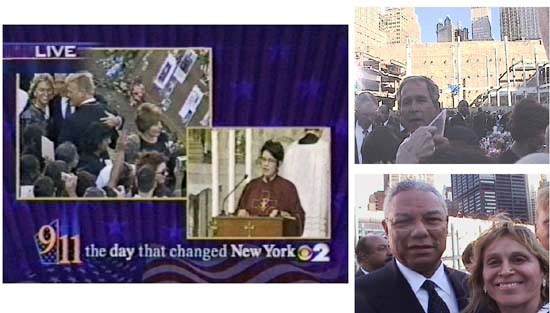
I carried with me copies of the "Towers
of Light"
song on a CD-the principal way music was
shared at the time. When I reached the "pit"- the
vast space where the towers had stood—a WCBS-TV camera crew
recorded my encounter with President George W. Bush. I told
him about my service at the site and, as the news footage
that aired showed, he hugged me and kissed me on the cheek.
I gave him a copy of the CD and also presented copies to
Secretary of State Colin Powell and New York City Mayor
Michael Bloomberg. |
|
|
 |
|
WCBS-TV news footage of Dr. Judy Kuriansky
with President Bush and Secretary of State Colin Powell, and
giving them a CD copy of the "Towers
of Light" song |
|
|
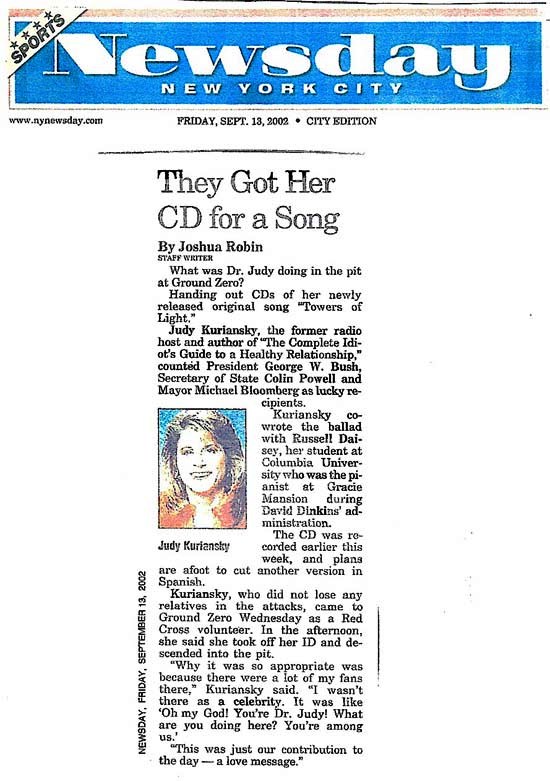 |
Newsday article about Dr. Kuriansky giving
the CD of the song
to President Bush and others |
|
|
|
Later that day, Russell performed "Towers
of Light"
at Milbank Chapel at Teachers College and at
Columbia University’s
standing-room-only memorial in St. Paul's
Chapel.
On that first anniversary, the anthem had
begun its public life.
The song performed for Nobel Peace Laureates
One of the song's
most remarkable journeys took us to Hiroshima in the autumn
of 2006. We were invited to perform at the First Hiroshima
International Peace Summit by the Hiroshima Junior Chamber
of Commerce, the Mayor of Hiroshima, and Japanese
firefighters who had assisted at Ground Zero and who had
heard us perform the song at the 2006 Annual 9/11 Japanese
Floating Lantern Ceremony on the Hudson River.
The public gathering at the Astor Plaza Grand Hall drew an
audience of 1,200 people. It opened with an address by His
Holiness the Dalai Lama on compassion and humanity, followed
by a panel discussion with the Dalai Lama, Archbishop
Emeritus Desmond Tutu, and Nobel Peace laureate Betty
Williams. Williams had won the peace prize for courageously
co-founding a grassroots movement in 1976 to help end the
violent sectarian conflict in Northern Ireland.
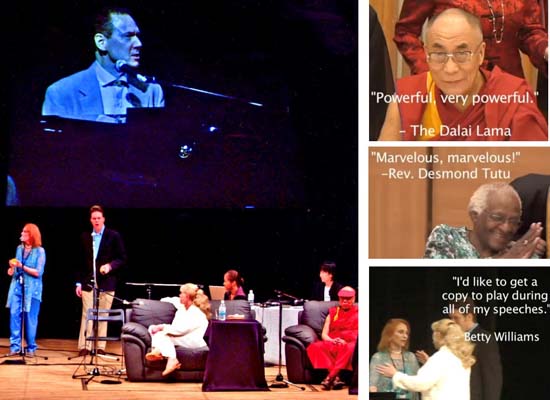
After the panel, with the three Nobel Peace
Prize laureates still seated on stage, Russell performed
"Towers
of Light"
at the piano while my former student Neil
Walsh, who had come on the trip with us, and I sang with
him. |
|
|
 |
|
(at top, projected, seated at piano): Russell
Daisey; (front row, left to right, standing): Dr. Judy
Kuriansky, Neil Walsh; (seated): Betty Williams, HH the
Dalai Lama (missing further right) Archbishop Emeritus
Desmond Tutu, on 11/02/2006 |
|
|
|
When the song ended, Betty Williams told Russell, "II
want to play your song before every speech I give."
One of Russell’s
most unforgettable moments came when the Dalai Lama rose,
crossed the stage, and took his hands. In his unmistakable
resonant voice, the Dalai Lama offered his response to
Russell about the performance of the song: "Powerful.
Very powerful."
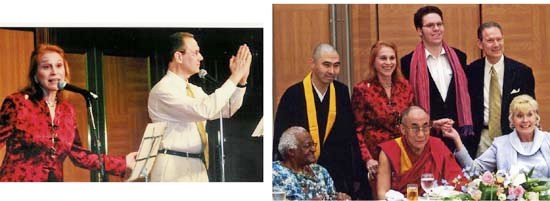
On the second day of the peace summit, a luncheon was hosted
by the Hiroshima Junior Chamber of Commerce and the Office
of the Mayor. This celebratory event, held in the Grand
Prince Hotel Hiroshima ballroom, consisted of speeches,
toasts, and taiko drumming. It was especially meaningful to
debut our newly composed peace anthem, "Stand
Up for Peace."
After the performance, we were again pleased with the
reactions of the Nobel laureates. Archbishop Emeritus Tutu
told us, "This
is a great song for peace."
And Betty Williams asked if she could get a recording of
"Stand
Up For Peace"
to learn the words, since she also wanted to
sing it with us in the near future. |
|
|
 |
|
At the Hiroshima International Peace Summit
second-day luncheon (left photo) Dr. Judy Kuriansky and
Russell Daisey giving the debut performance of their "Stand
Up for Peace"
song (right photo, seated from left to right)
Archbishop Emeritus Desmond Tutu, HH the Dalai Lama, Betty
Williams (standing, from left): Reverend TK Nakagaki, Dr.
Judy Kuriansky, Neil Walsh, Russell Daisey |
|
|
|
Public Ceremonies with the Military
Performances at events with color guards and military
salutes are especially moving. This is particularly true for
both Russell and me, growing up as children of military
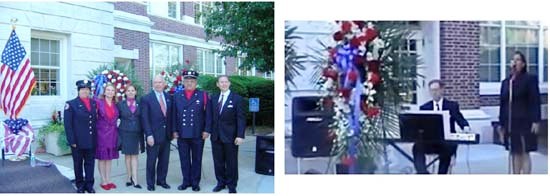
fathers. On 9/11/2005, we were invited to perform the TOL
song at a special ceremony at the Town Hall in Greenwich,
Connecticut, featuring a color guard, a three-gun salute,
and speeches by local politicians and dignitaries. The
public sat in chairs on the sprawling lawn. |
|
|
 |
|
(left) Town Hall memorial in Greenwich,
Connecticut on 9/11/2005 (from left); firefighter, Dr. Judy
Kuriansky, Juliana Oliveri, town official, fireman, Russell
Daisey; (right) Russell Daisey & Juliana Oliveri singing (TOL)
|
|
|
|
Russell played keyboards accompanying the vocals of singer
and good friend, Juliana Olivieri, who had lost many
hospitality colleagues at the famous Windows on the World
restaurant on the 106th and 107th floors of the North Tower
of the World Trade Center. Olivieri's
singing was especially moving, as her Judy Garland-like
voice gave the song a deep, resonant power. The experience
for us was also especially emotionally vulnerable, given
that Olivieri was about to start chemotherapy treatment for
leukemia.
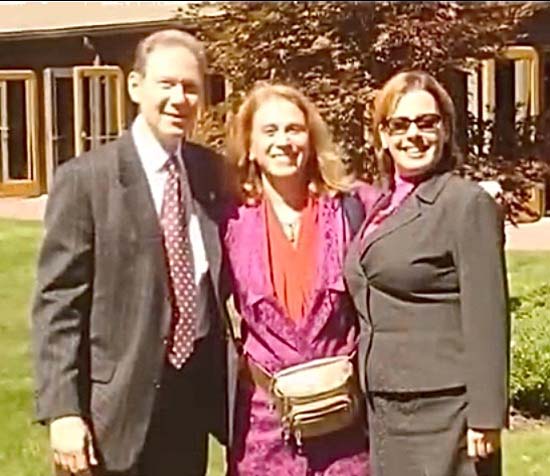
The team was then invited by Father Michael to perform the
TOL song at the Sunday service at St. Michael the Archangel
Church parish which followed the ceremony. This was
especially significant given that eleven members of the
congregation had died in the Twin Towers inferno.
After the song, Father Michael said, 'Let
us appreciate the many blessings that God has given us,"
adding, "This
song has made it easier for us to pray." |
|
|
 |
|
Russell, Dr. Judy and Juliana Oliveri at St.
Michael the Archangel Roman Catholic Church in Greenwich,
Connecticut, after the Sunday service with performance of
the TOL song, on 9/11/2005 |
|
|
|
A Musical Bridge to Japan
The First Hiroshima International Peace Summit transformed
our musical lives by introducing us to Japanese
singer-songwriter and peace advocate Shinji Harada. A major
rock star in Japan, Shinji is known by his many admirers as
"the
Beatles of Japan."
Shinji invited us to perform in his Charity
Peace Concert to happen the evening after the Summit, in
front of the ancient Hiroshima Castle. The historic building
from the 1590s had been reconstructed after being destroyed
in the WWII atomic bombing.
The performance for us was historic. It happened on a
beautiful 72-degree starry November night, attended by 1,000
appreciative people. The extravaganza consisted of stunning
performances by the Hiroshima Boys Choir, traditional and
hip-hop dancers, and virtuoso koto and taiko musicians. In
the dramatic opening, Shinji appeared on, and descended
from, a high staircase lit by lasers. |
|
|
 |
|
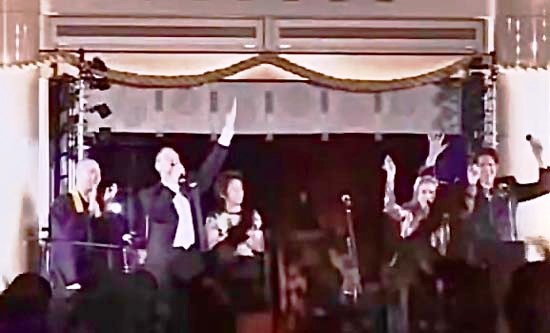
The Global Harmony Charity concert at
Hiroshima Castle on 11/03/2006 (left to right: Reverend T.K.
Nakagaki, Russell Daisey, Shinji Harada, Dr. Judy Kuriansky,
Neil Walsh |
|
|
|
Over the next six years, we returned to Japan for Shinji’s
Global Harmony Peace-and-Music tours, performing in
Hiroshima, Nagasaki, Fukushima, and Tokyo. We also welcomed
him to New York, to perform with us in concerts, memorials,
and United Nations events, as well as to join us in Mexico
City at the opening night concert of the 2009 United Nations
Department of Public Information DPI/NGO world conference at
the prestigious Foro de Ensayo de Orquesta de Bellas Artes
concert hall. |
|
|
 |
|
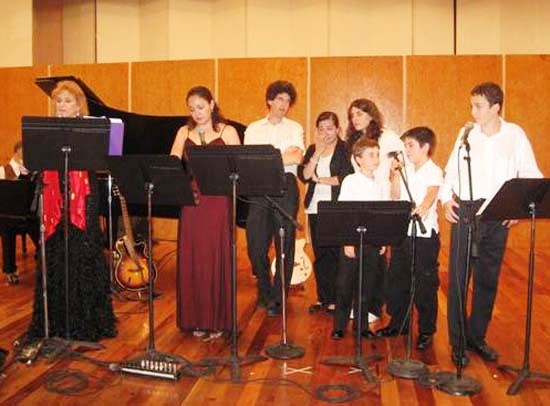
Dr. Judy (far left) with a choir and Mexico
City architect/peace activist Sergio Kopeliovich (back row)
onstage at the opening night of the DPI/NGO world conference
concert in Mexico City, 9/11/2009 |
|
|
 |
|
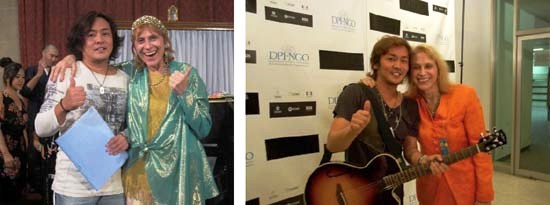
Dr. Judy with Shinji Harada
|
|
|
 |
|
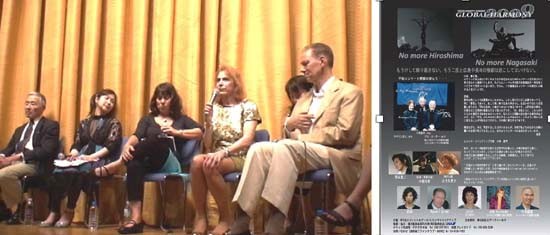
Speaking on a panel in Japan before a Global
Harmony
concert |
|
|
|
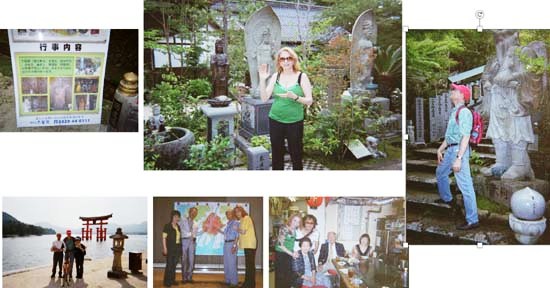
Concert trips throughout Japan were filled with celebrations
with old and new friends, education including about the
nuclear disasters, and visiting spiritual sites. The
Buddhist statues align so emotionally deeply of my years of
tantra teachings. |
|
|
 |
|
Concert trips throughout Japan 2008 |
|
|
|
From 9/11 to 3/11
Another important Japanese musical collaborator, besides
Shinji, was classical-crossover soprano, Tomoko Shibata,
whom we met through Reverend T. K. Nakagaki, former head
resident minister of the New York Buddhist Church, longtime
organizer of New York's
Annual 9/11 Japanese Floating Lantern Ceremonies. Beginning
in 2010, Tomoko brought her extraordinary range and musical
intensity to performances we did of the "Towers
of Light"
song in New York, Hawaii and Japan.
With Tomoko, the song became a bridge between
America’s
September 11 tragedy (known simply as "9/11"and Japan’s
March 11, 2011 earthquake, tsunami and nuclear crisis, that
came to be known as simply "3/11"
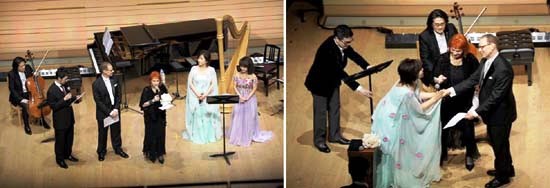
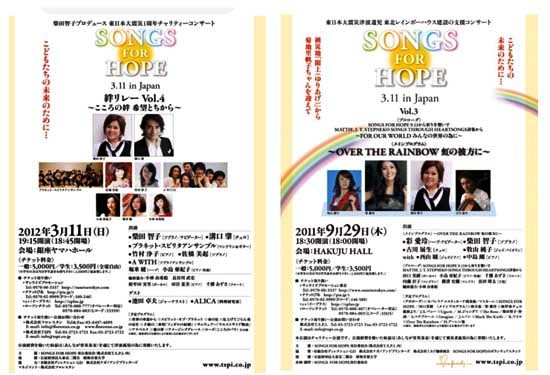
In March 2012, Russell and I were invited by
Tomoko to join her in her sold-out and greatly acclaimed
"Songs
for Hope"
memorial concert at Tokyo's
prestigious Yamaha Hall, marking the Japan 3/11 disaster’s
first anniversary. Proceeds supported a home for children
orphaned by the catastrophe. In an especially significant
gesture that opened our eyes even wider to the international
relevance of our song, Shibata translated "Towers
of Light"
into Japanese. At the concert, she led a new
classical-crossover arrangement featuring voices, flute,
harp, cello and piano. |
|
|
 |
|
(left photo) Songs for Hope
charity concert in Tokyo's Yamaha Hall on 3/11/2012) (third from left: Russell Daisey,
Dr. Judy Kuriansky (speaking), Tomoko Shibata (in blue).
(right photo): musicians with Tomoko congratulating Russell
and Dr. Judy |
|
|
|
My 'Songs for Hope' concerts
are my way of keeping people's
spirits lifted through the art form I know-music,"
Shibata has said. "Music
can help heal people's sorrow at this sad time in my country.' Her sentiment aligns
with my psychological observations about such meaning in
music. |
|
|
 |
|
Programs from 2011 and 2012 "Songs
of Hope" concerts |
|
|
|
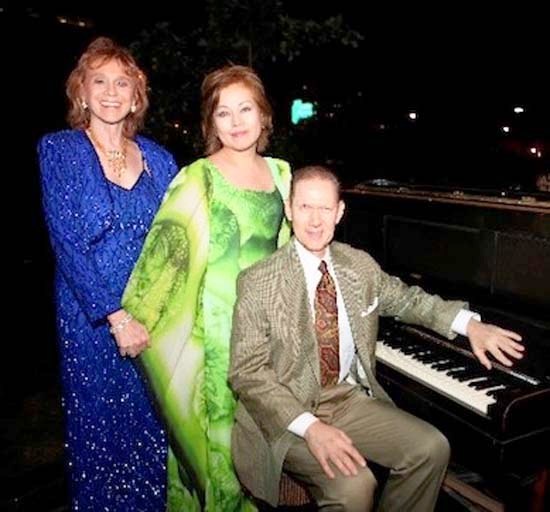
Shibata sang our
anthem in many settings. These included in September 2010,
for the highly-praised “Hibaku” (survivor) piano concert
series in New York City which honors the “Hiroshima
Hibakusha” (survivors of the atomic bombings of Japan during
WWII); for the 9th Anniversary of 9/11 at the Annual 9/11
Japanese Floating Lantern Ceremony on the Hudson River; and
for concerts at the Church of Saint Paul and Saint Andrew,
the New York Buddhist Church, and the Tillman Chapel of the
Church Center for the United Nations. Bridging these
cultural boundaries – whereby Japanese souls similarly
became the “new stars” in the song lyrics – consolidated (my
favorite) concept that music is a powerful tool for “soft
diplomacy.” |
|
|
 |
|
(from left) Dr. Judy Kuriansky, Tomoko
Shibata and Russell Daisey with the Hibaku (survivor) piano
at the Annual 9/11 Japanese Floating Lantern Ceremony on the
Hudson River, on 9/11/2010 |
|
|
|
In late September 2011, we performed TOL at another of
Tomoko's "Songs
for Hope"
charity concerts, this time at Tokyo's Hakuju Hall. Singing with a children's
choir whose members had survived the tsunami gave the music
an emotional depth none of us could forget.
At this event, I also made a speech about the powerful
connection between the two countries of Japan and America
about the tragic events. Research shows that close family
and community connections foster healing; knowing that we
are not alone-even across great distances-can be deeply
comforting. I use this principle in an exercise I do with
children around the world in my workshops after disasters.
Children gather around the map I show them of disaster
sites, showing intrigue and even glee when recognizing that
children in different places around the world are feeling
the same as they are.
|
|
|
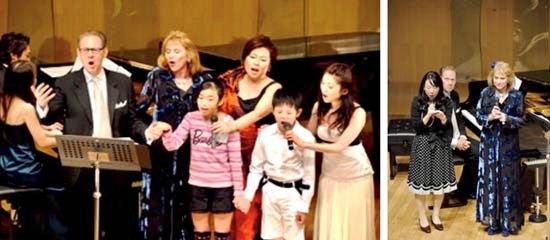 |
(left photo): onstage at the "Songs for Hope"
concert at Hakuju Hall, Tokyo (from left) Russell Daisey,
Dr. Judy Kuriansky, and Tomoko Shibata, with children
tsunami
survivors
(right photo): Russell seated at the piano while Dr. Judy
gave a speech translated into Japanese by good friend Yoko
Urbain |
|
|
|
I bonded with Tomoko on another level, namely, our
commitment to advocacy on behalf of the rights and
empowerment of women and girls. I had co-organized
innumerable events for the United Nations Commission on the
Status of Women (CSW) over years -- at which Russell and I
also performed many of our anthems.
For this reason, it was particularly rewarding that Tomoko
performed our Towers of Light song at one of these events.
The CSW conference occurs annually in March, with both a
government and a non-government version that feature
discussions and live and online meetings dedicated to gender
equality and women's empowerment. |
|
|
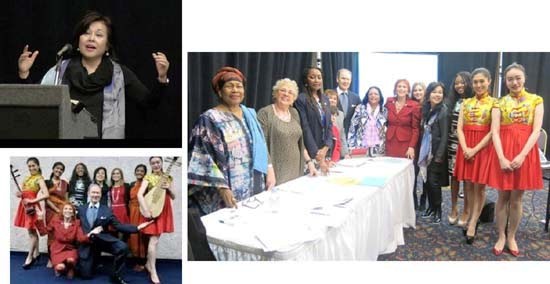 |
|
Tomoko Shibata singing "Towers
of Light" and the entire panel of speakers and
performers at the United Nations Commission on the Status of
Women event on 3/12/2015 |
|
|
|
Symbols of Peace
The "Towers
of Light"
song has been performed at many world peace
events, given that the 9/11 terrorist attack demands
awareness of the dire need for peace in the world.
Appropriately for the peace theme of the occasions, we also
sang our "Stand
Up for Peace"
song.
Given this connection between our music and
peace, Shinji invited us to join many of his famous "Global
Harmony Peace Symposia and Concerts"
(mentioned above) throughout Japan over the
years 2007-2011. These occurred in Fukushima and Hiroshima
(2007); Hiroshima and Tokyo (2008); Hiroshima and Nagasaki
(2009); at the UN Department of Public Information opening
night concert in Mexico City (2009); Hiroshima and Tokyo
(2010, 2011); Sendai on the day after the first anniversary
of the tsunami tragedy, in numerous schools and senior
centers (March, 2012), and at the United Nations Culture of
Peace High-Level Forum in New York City (2013).
|
|
|
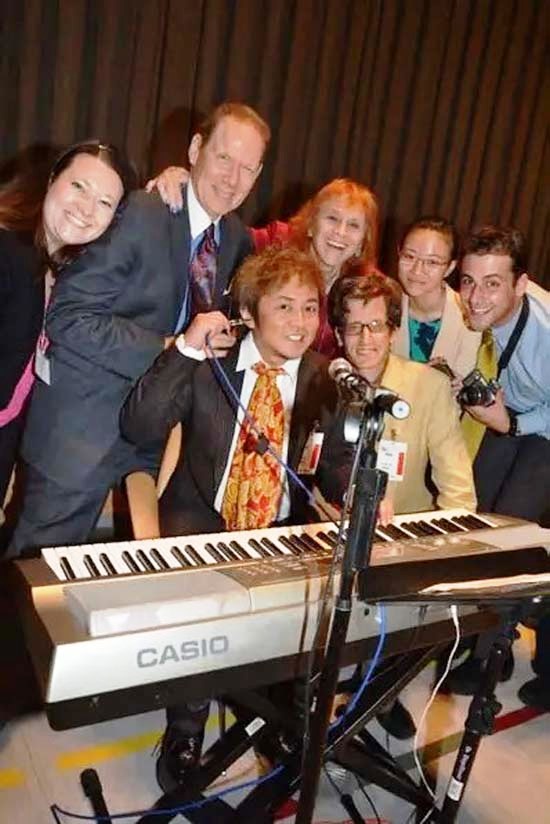 |
|
Performance during the United Nations Culture
of Peace High-Level Forum on 9/06/2013, with Shinji Harada
(seated at keyboard) and Russell Daisey and Dr. Judy
Kuriansky (behind) surrounded by friends and event
organizers. |
|
|
|
On many of these occasions, we recruited local children’s
choirs. Meeting children in each Japanese city was a joyous
treat. We were especially delighted when the Japanese
children had proudly learned the lyrics in English.
Besides the peace concerts for Shinji, we also performed the
TOL song at Universal Peace Day ceremonies throughout
2007-2019, which were organized by our friend, peace
activist SuZen. Particularly committed to preserving the
history of the survivors of the nuclear bombing of Hiroshima
and Nagasaki, Suzen started these events in 1984 and held
them at various Manhattan sites, including Riverside Church,
the Church of Saint Paul and Saint Andrew, the New York
Buddhist Church, Dag Hammerskjöld
Plaza, St. John’s
Lutheran Church, and in Union Square Park at the statue of
Mahatma Gandhi. These Universal Peace Day ceremonies
featured music, dance, poetry, speakers on peace and
non-atomic proliferation and the
"Hibakusha"
survivors of the Hiroshima and Nagasaki
atomic bombings. Some of these concerts were performed on
August 6 or August 9 -- the days that mark the atomic
bombings in 1945 -- when Japan observes its major annual
peace memorials and pray for a peaceful, nuclear-free world. |
|
|
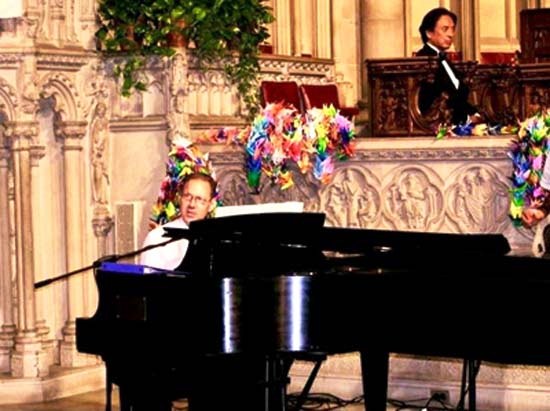 |
|
Russell Daisey singing TOL at Riverside
Church for Universal Peace Day ceremony on 8/05/2008 |
|
|
|
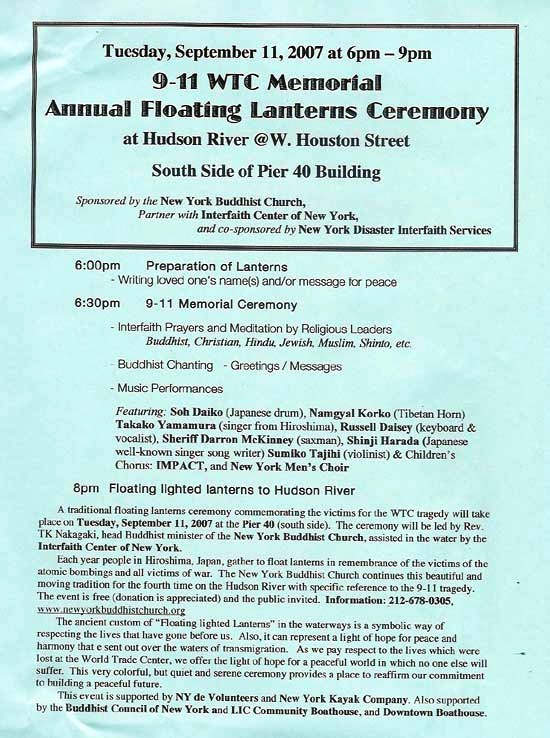
The Floating Lanterns
Continuing the theme of peace, from 2006 through 2011,
"Towers
of Light"
was performed at New York’s
Annual 9/11 Japanese Floating Lantern Ceremonies on the
Hudson River. |
|
|
 |
|
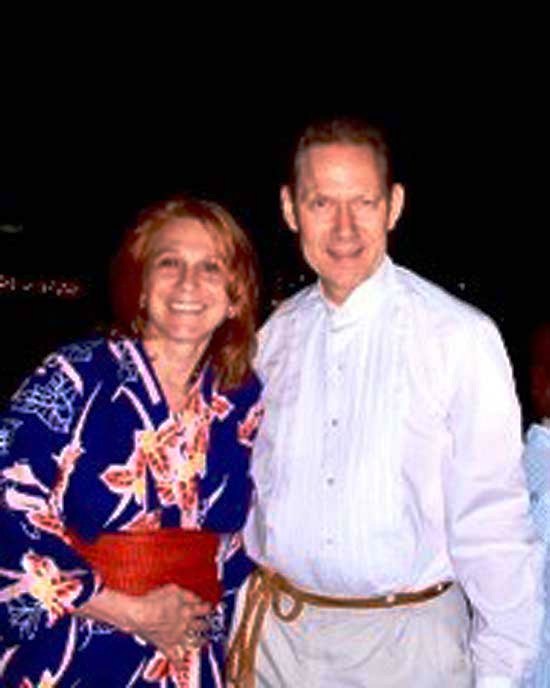
Dr. Judy Kuriansky and Russell Daisey on the
Hudson River Pier 40 at the Annual 9/11 Japanese Floating
Lantern Ceremony on 9/11/2006 |
|
|
 |
|
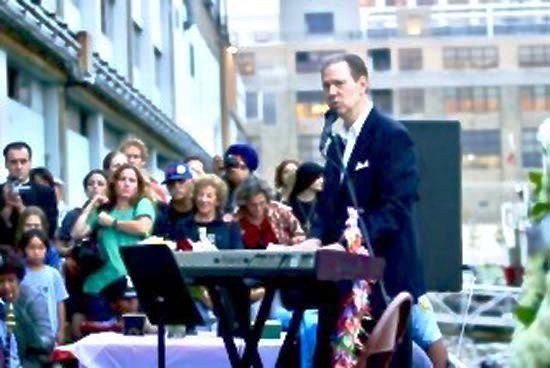
Russell Daisey at the keyboard performing TOL
at the 9/11 Annual Floating Lantern Ceremony on Pier 40 on
the Hudson River, on 9/11/2008 |
|
|
|
We had been first invited to perform this song by Reverend
T.K. Nakagaki (mentioned above) in September 2006 after he
heard Russell perform "Towers
of Light"
at the Church Center for the United Nations.
Reverend T.K. (as he is fondly called, as Shinji and Tomoko,
became a very close friend, creating a circle of friends in
an international bond that we cherish.
A Buddhist priest, Rev. Dr. T. Kenjitsu Nakagaki is founder
of the Heiwa Peace and Reconciliation Foundation of New
York, an honorary board member of the Interfaith Center of
New York, and New York City Police Department Clergy
Liaison. A Hiroshima Peace Ambassador, he has organized an
Interfaith Peace event to commemorate the Hiroshima and
Nagasaki atomic bombings since 1994 and organized the annual
9/11
Japanese Floating Lantern Ceremonies
from 2002-2011.
At these floating lantern ceremonies, leaders representing
many faiths offer prayers, meditations and blessings.
Members of the public write messages on rice-paper lanterns,
which are set afloat at sundown. Some carry photographs of
rescue workers who had died; others bear messages from
children in Japan |
|
|
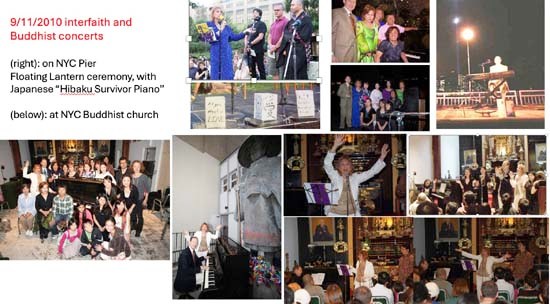 |
(top row) Kuriansky hosting the 2010 9/11
Annual Japanese Floating Lantern Ceremony onstage with
Reverend TK Nakagaki (at the right); (underneath) rice paper
floating lanterns; (middle) Daisey, Shibata, Kuriansky,
piano tuner & Harada (seated); (underneath) Daisey,
Kuriansky, Harada (seated)
and Shibata (standing at right); Russell Daisey seated at
piano on the Pier; (lower row from left) Hibaku piano family
at NY Buddhist Church; Daisey and Kuriansky with Hibaku
piano and Shinran Shonin survivor statue from Hiroshima;
(upper left) Dr. Judy singing with arms elevated; (upper
right) Hibaku piano group singing together; (lower left) Dr.
Judy speaking and teaching song lyrics at the New York
Buddhist Church event |
|
|
 |
|
|
|
"Through this tradition, peace and harmony are sent out over
the waters into the universe,"
Reverend Nakagaki said.
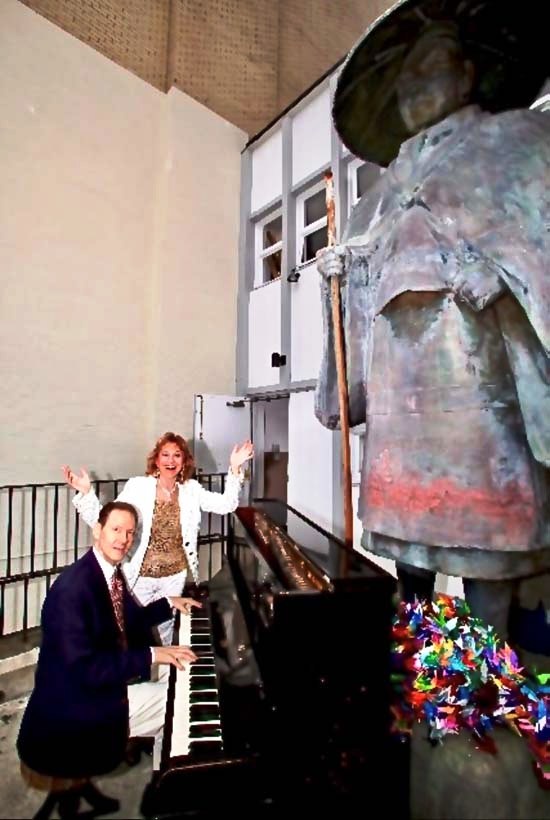
At the 2010 ceremony, Russell played the
Hibaku piano that had survived the atomic bombing of
Hiroshima. The instrument had been brought from Japan
–
costing tens of thousands of dollars expended willingly
because of love -- as a living witness to survival and
reconciliation.
Continuing the Japanese connection, Russell
performed "Towers
of Light"
and an original song, "He
Stood There Watching",
composed to commemorate the statue of Shinran Shonin that
has great significance in that it survived the atomic
bombing of Hiroshima. It now stands in front of the New York
Buddhist Church on Riverside Drive in New York City. |
|
|
 |
|
Dr. Judy Kuriansky with Russell Daisey seated
at the Hibaku (survivor) piano, beside the Shinran Shonin
statue (which survived the atomic bombing of Hiroshima) in
front of the New York Buddhist Church on 9/13/2010 |
|
|
|
Towers of Light”
in Sacred Spaces
The spiritual resonance of "Towers
of Light"
has also brought it into many houses of
worship representing a variety of denominations and
religious traditions.
This perfectly aligns with my work at the United Nations
co-organizing annual events for the UN World Interfaith
Harmony Week (See:
https://webtv.un.org/en/asset/k18/k18jyvglr6) . Performing at these various venues has
given us an intense spiritual awakening and appreciation of
the power of worship. The traditions include; Roman Catholic
(Saint Michael the Archangel Parish in Greenwich,
Connecticut); Episcopal (St. Paul’s
Chapel of Trinity Church); interdenominational—American
Baptist and United Church of Christ (New York City’s
Riverside Church); Lutheran (Evangelical Lutheran Church in
America AKA St. John’s
Lutheran Church); Methodist (the Church of St. Paul & St.
Andrew); nondenominational and multi-faith (St. Paul’s
Chapel at Columbia University); nonsectarian academic
(Milbank Chapel at Teachers College, Columbia University);
ecumenical and interfaith (Tillman Chapel at the Church
Center for the United Nations); Jewish (Old Westbury Hebrew
Congregation in Old Westbury, New York); and Buddhist (the
New York Buddhist Church and the Buddhist Church of San
Francisco, California). |
|
|
 |
|
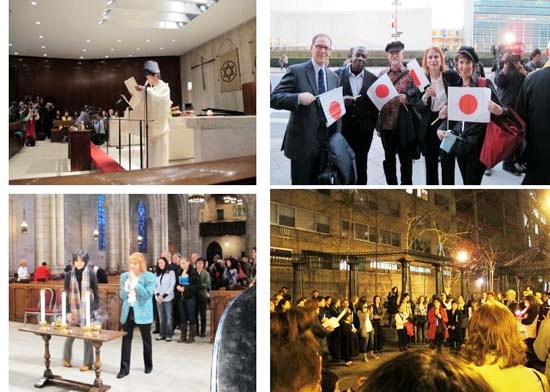
(Top) inside and outside the Tillman Chapel
of the Church Center for the United Nations; (bottom)
Riverside Church and
Dag Hammerskjöld
Plaza, |
|
|
|
Pearl Harbor and other traumas
One of the most formidable sites in America
invoking the need for peace is Pearl Harbor, the U.S. naval
base in Hawaii that was the site of the devastating surprise
attack by Japan on December 7, 1941, which forced the United
States to enter World War II.
For that reason, it was significant for Russell to perform
our "Towers
of Light"
song on September 11, 2014, at the USS Bowfin
Submarine Museum (aka Pacific Fleet Submarine Museum) at
Pearl Harbor. It was also significant that once again our
Japanese friend Tomoko Shibata joined in song. The
invitation came from a friend, Vincent Forras, a volunteer
firefighter who had rushed to Ground Zero after the 9/11
attacks and spent months searching for survivors in the
rubble. Vincent and Dr. Judy particularly bonded because,
like many other responders at the site, they both
experienced respiratory problems from toxic exposure to the
dust and rubble, spending extensive time at the
"pit".
Though suffering terribly from these physical ailments but
with his heart of gold, Vincent became an advocate for sick
responders and founded the GearUp Foundation, a non-profit
that provides fire and rescue equipment to international
fire brigades.
The event was hosted by our good friend, award-winning
journalist and host on TV and radio, Rita Cosby, who also
has a heart for military events, given her father's
role as a teenage Polish resistance fighter in WWII. Rita,
who wrote about his life in the best-selling book "Quiet
Hero: Secrets From My Father's
Past",
actively supports veterans, military families, and awareness
programs for PTSD.
Also performing were her partner, musician/singer Tomaczek
Bednarek, from a famed military family, who performs at
numerous 9/11 and patriotic events; Daniel Rodriguez, the
retired New York City police officer who became known after
9/11 as "the
Singing Policeman", who sang patriotic and other powerfully
emotional songs; musician/singer actress and iconic 1980s
model Kelly LeBrock (known famously for saying "Don’t
hate me because I'm
beautiful"
and the Highland Divas. |
|
|
 |
|
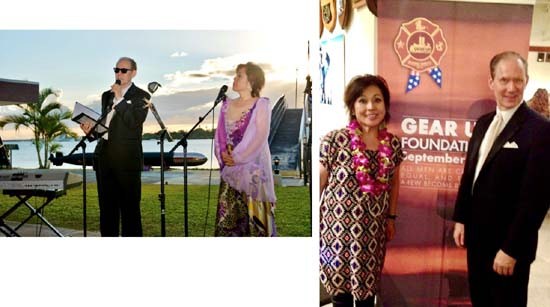
Russell Daisey & Tomoko Shibata at Gear Up
Foundation memorial and concert at the USS Bowfin Submarine
Museum, 9/11/2014 |
|
|
|
A song has value when it speaks to people on sacred
occasions like 9/11/2014 at Pearl Harbor, and wherever
people have experienced trauma.
For that reason, singing "Towers
of Light"
has been powerful in inspiring resilience on
so many occasions where Russell and I have conducted my
resilience workshops around the world after traumatic
natural disasters.
The
tempo of a song can be changed to be slow and solemn or more
lively and uplifting. |
|
|
 |
|
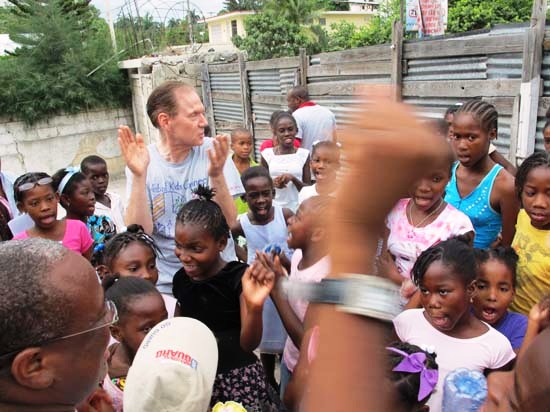
Russell singing with children in Haiti |
|
Another towering sculpture
"rises"
to the occasion
Architectural structures help with healing from disasters as
they serve as symbols of strength and as places that bring
communities together. They can inspire a spiritual sense of
renewal, resurrection, and hope.
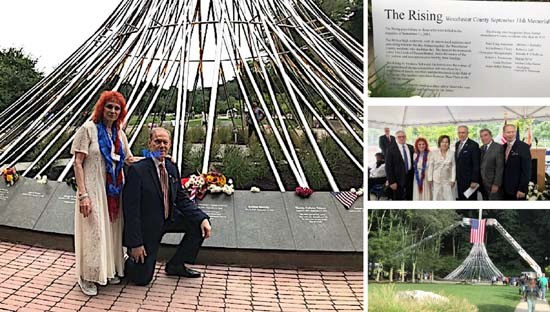
Like the Freedom Tower built at Ground Zero,
"The
Rising"
at the Kensico Dam in Valhalla, New York, is
a notable example. This Westchester County 9/11 memorial is
an 18-ton stainless-steel sculpture, formed by intertwining
rods that reach toward the sky in memory of the one hundred
and eleven local residents who died in the attacks.
"The
Rising"
is purposefully named after the Bruce
Springsteen song, with lyrics about a New York City
firefighter who climbs the smoke-filled stairwells of the
World Trade Center to save others, overcoming any fear out
of the drive for duty, self-sacrifice, and love of others.
In 2018, Russell and Tomoko joined up again to perform TOL
at "The
Rising",
at the invitation of Russell’s
dear friend Congresswoman Nita Lowey, who served the county
in the U.S. House of Representatives for 32 years. |
|
|
 |
|
Dr. Judy Kuriansky, Russell Daisey, and
Tomoko Shibata with community leaders at "The
Rising" 9/11 memorial |
|
|
|
Remembering,
with Governor George Pataki
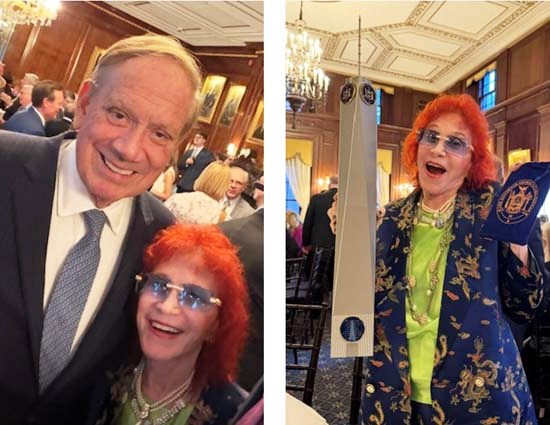
George Pataki was Governor of New York at the
time of the attacks and led the state's recovery response
alongside then-Mayor of New York City, Rudy Giuliani, who
had become known fondly as
"America's
Mayor"
for his admired handling of the recovery
after the attacks. The Governor, also admired for his
response, especially to rebuild the downtown area and
restore the economy, holds annual events for his Pataki
Center, which I attend, that recall the courage and
resilience of the recovery, honor his team, and promote
education and support for other disasters, like in Ukraine.
He is credited with coining the name "Freedom
Tower"
for the structure that now stands at the
attack site. |
|
|
 |
|
Dr. Judy Kuriansky with Governor Pataki and
replica of the Freedom Tower given out at his Pataki Center
Gala 2026 |
|
|
|
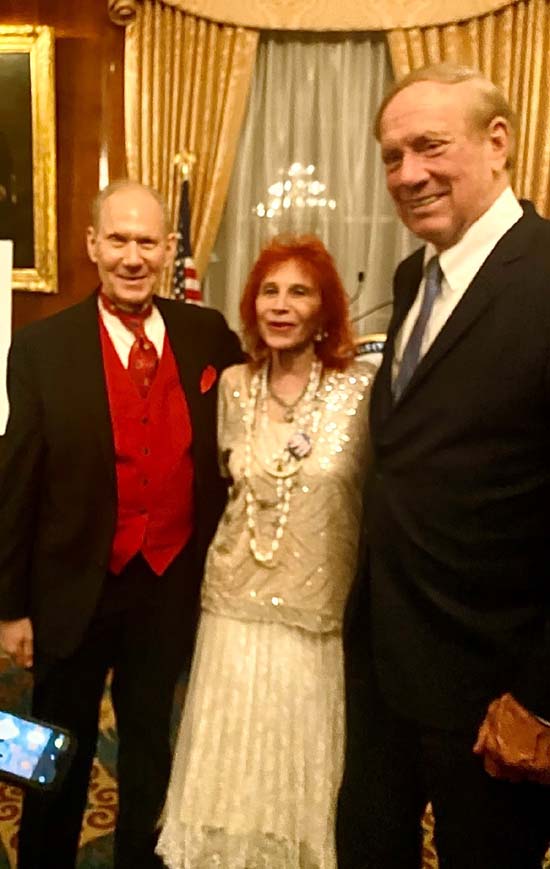
Russell performed "Towers
of Light" at a Pataki Leadership Center luncheon in Lower
Manhattan on September 11, 2019, onstage with Governor
Pataki and Daniel Libeskind, whose 2003 master plan
established the framework for rebuilding the World Trade
Center site with its memorial, museum, transit hub and
ascending spiral of new skyscrapers.
|
|
|
 |
|
Russell Daisey, Dr. Judy Kuriansky and
Governor George Pataki at the annual 9/11 Pataki Center
awards ceremony and cocktail reception, 9/11/2025 |
|
|
"Towers of Light"
with Notable Figures
Through the years, "Towers
of Light"
has been presented on programs with notable
persons. These include scholars (Professor Robert Thurman);
politicians (Congresswoman Nita Lowey); faith leaders
(Reverend Dr. James A Forbes, Riverside Church senior
minister for 30 years); media personalities (Rita Cosby,
Stephanie Miller); as well as other singers, musicians,
composers (Peter Yarrow; soprano saxophonist Paul Winter
famed for his Winter Solstice Celebrations at St. John the
Divine and 30-year-long producer of sold-out new-age
concerts; David Amram, New York Philharmonic
composer-in-residence and composer of film scores "Splendor
in the Grass"
"Seven
Days In May"
and
"The
Manchurian Candidate";
and Bunken Nagano, noted Hiroshima-native classical
guitarist who accompanied me in a poetry reading at
Riverside Church. |
|
|
 |
|
Peter Yarrow, Dr. Judy Kuriansky |
|
|
|
Family and Friends Matter Most
Research shows that support (and love) of others is the most
important factor in healing. Family matters. For Russell and
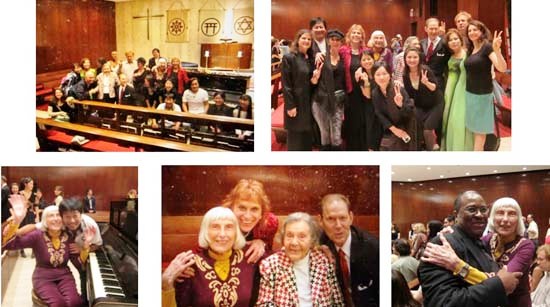
me, bringing our mothers, Sylvia and Ellie, when we
performed "Towers
of Light"
at the Tillman Chapel of the United Nations
Church Center in 2010 was especially meaningful. That
occasion was boosted by also having good friends present.
Shinji and Tomoko joined us in singing an extensive concert
and ceremony with the
"Hibaku
Survivor Piano"
that survived the Hiroshima Bombing (mentioned above).
Tomoko and Russell performed TOL. Tomoko also sang Puccini's
"Vissi
d’arte"
with Russell’s
piano accompaniment. In the spirit of peace, Shinji
performed his world-famous peace anthems, and our vocal
quartet group sang the "Stand
Up for Peace"
anthem.
The affirmation of friendship was deepened by
the presence of our dear friend, Father Wismick Jean
Charles, a Haitian Catholic priest, who traveled from Haiti
to join us. My bond with Father Wismick is intense,
especially over recovery from tragedies, from the fateful
day in 2010 when I traveled with him immediately upon
learning of the tragic earthquake in his country. After
that, Russell and I went to Haiti every year to conduct my
unique psychosocial recovery workshops for the communities
-- until the recent gang kidnappings that made going there
too dangerous. Russell always sang many songs for the groups
and for Father Wismick's
conferences, including our Haitian post-earthquake recovery
anthem "Reeds
in the Wind"
-even singing in
the native language of Creole.
He also led
conga lines with the children, much to their delight.
|
|
|
 |
|
Photos from the Hibaku (survivor) piano
concert at the Tillman Chapel of the Church Center for the
United Nations. (bottom left) my mother Sylvia Sporn with
Hibaku piano tuner; Russell and I with our moms, Sylvia
Sporn and Eleanor Daisey; Father Wismick Jean Charles with
my mom; (upper left): group including Heather Nakagaki,
Tomoko Shibata, Rev. TK Nakagaki, Eleanor Daisey, Russell
Daisey, Barry Gruber, SuZen, Sylvia Sporn, Dr. Judy
Kuriansky, Shinji Harada; (upper right, left to right, back
row): Juli Cooper, Kenji Nagano, SuZen, Dr. Judy Kuriansky,
Sylvia Sporn, Eleanor Daisey, Russell Daisey, Tomoko
Shibata, Barry Gruber, Heather Nakagaki. |
|
|
|
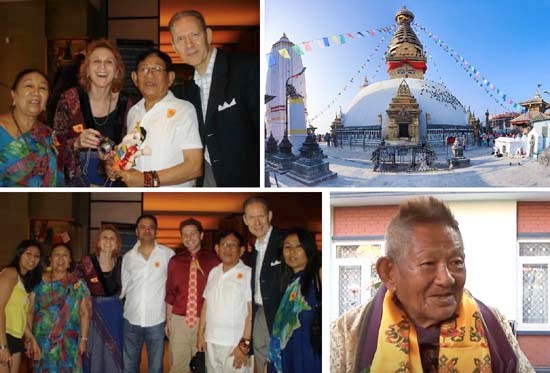
Special occasions of close friends have been especially
meaningful times of singing "Towers
of Light."
It was perfectly touching in times of joy,
like when we performed it for our good friends, the Chiniya
Lama of Boudha, Kathmandu, Nepal, and his wife Durga, on the
occasion of the 50th wedding anniversary). And
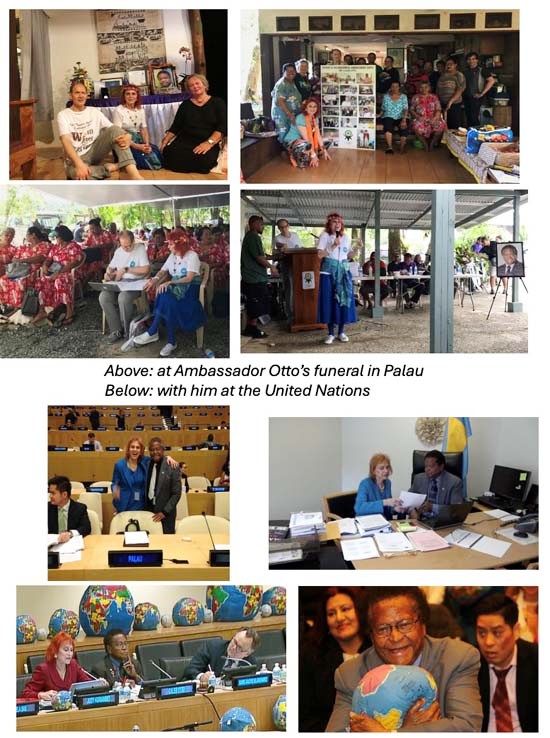
also, in times of extreme sadness, as when we traveled to
Palau in November 2018, to the three-day-long State funeral
memorials of my beloved friend and colleague, Ambassador
Caleb Otto. A gift to the world with his big heart,
kindness, and brilliant mind, Ambassador Otto and I teamed
up for one of the most impactful experiences of my life
–
conducting a successful advocacy campaign to ensure the
inclusion of mental health and wellbeing in the United
Nations Agenda 2030 for Sustainable Development. So much
credit goes to his being so respected by the government
member states at the UN. He loved the song. Russell had sung
it on many occasions at our UN events. |
|
|
 |
|
The 50th anniversary of the Chiniya Lama of
Nepal and his wife |
|
|
 |
|
|
|
An Educational Tool
Music is not only entertaining and empowering but also
educational. Over the past 22 years of my teaching at
Columbia University Teachers College – since that first year
when I was teaching the ”Psychology of Human Intimacy” when we wrote the "Towers
of Light" song as homework healing from the terrorist
attacks -- Russell has sung the song innumerable times in my
class. Students were moved and awed, saying they had never
been to a class like mine -- in many ways -- but especially
where music accompanied so many subjects. His singing "Towers
of Light" was exceptionally appropriate for the modules on
peace or on trauma, which I taught in my class about "Psychology
and the United Nations" every fall and spring semester. This
was particularly powerful in those years when classes
already started before the actual date of September 11 when
singing such a song was so timely and set the tone for
lessons on "cultural
diplomacy" and on the United Nations Sustainable Development
Goals (which include peace) and on the connection between
mental health and wellbeing with goals for a better future
for the world. |
|
|
 |
|
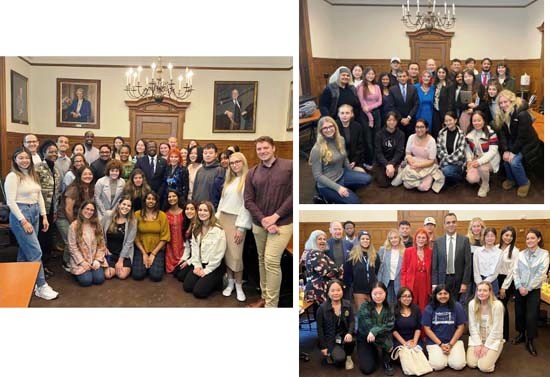
My Columbia Teachers College class with
Russell (back row, behind me in turquoise) after one of his
performances and guest presentations (on different days) by
Ambassadors to the United Nations: (left) Zambia (right
upper and lower) Oman and Pakistan |
|
|
|
In the Media
“Towers
of Light”
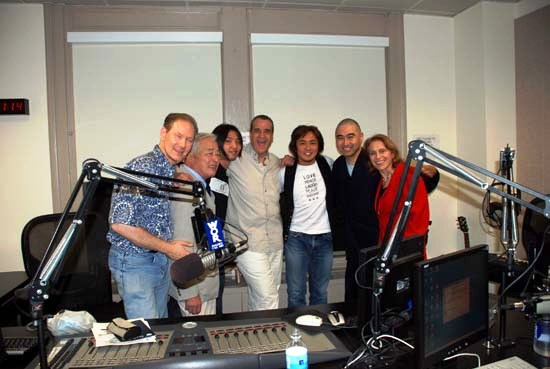
has been played on radio on Clear Channel
Radio, the Curtis Sliwa radio show, NPR Radio Florida, and
the Joey Reynolds talk radio show on WOR Radio on the 7th &
8th anniversaries of 9/11. On TV, Tomoko’s
Blueshore Tribute Concert performance was broadcast on Tokyo
TV, and performances have been on Good News events and
broadcasts. |
|
|
 |
|
On the Joey Reynolds Show: Russell (far
left), Joey (in the middle in white pants), ShinjiHarada,
Reverend T.K. Nakagaki, and Dr Judy |
|
|
 |
|
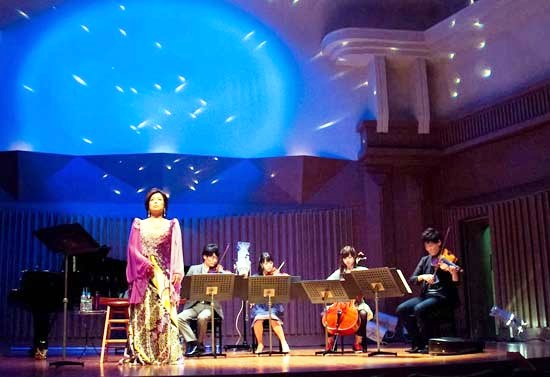
Tomoko Shibata singing
“Towers
of Light”
on TV in Tokyo |
|
|
|
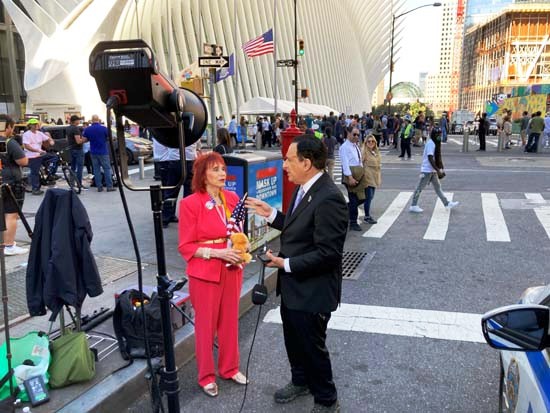
Also, I have been interviewed many times by media outlets,
speaking about my experiences as a first responder, giving
psychological advice, and referencing the Towers of Light
song. These have been on shows in America but also for other
countries, including Turkey and the Al-Hurra TV interview
shown in a photo above. |
|
|
 |
|
Dr. Judy Kuriansky being interviewed by Frank
Ucciardo for TRT World International News Channel about 9/11
anniversary reactions at the Oculus on 9/11/2021 |
|
|
|
Art and Recovery |
|
|
 |
|
|
|
The "Towers
of Light"
anthem’s
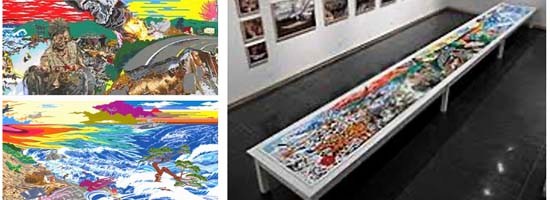
message has often intersected with other art forms. At an
event at the Art Students League of New York, we performed
the song to accompany the unveiling of an impressive 30-foot
scroll painting chronicling the journey from the 2011 Great
East Japan earthquake and tsunami crisis to recovery.
Japanese artist Jave Yoshimoto called his work "Baptism
of Concrete Estuary".
At this event, I gave a plenary speech about the role of art
and music in healing. This theme continues to inform my work
in cultural diplomacy at the United Nations, and in the
Arts4Peace signature events that I participate in for
Women4Diplomacy International, an organization I co-founded
with my good friend, Her Excellency Katalin Bogyay, a former
ambassador of Hungary to the UN and current President of the
Hungarian National Commission for UNESCO.
A songwriting partnership endures
“Towers
of Light”
began as a creative partnership of Russell
and me, that produced many events and songs connected to
global concerns and United Nations initiatives. Our anthems
have addressed peace, disaster recovery, mental health and
well-being, interfaith harmony, and the empowerment of women
and girls. They include "Stand
Up for Peace,"
"Every
Woman Every Child,"
"Happy
People, Happy Planet,"
"Hope
Is Alive,"
"One
in Faith"
and "Hands
Off Our Girls."
But these have been appreciated and sung by others from
varied cultures, showing the songs'
appeal to hearts and souls across borders.
These works have been presented at memorials,
peace summits, religious services, world congresses and
international summits, and public concerts. They've
gone from the simplest of places - a small New York City
park to Times Square to stages around the globe, including
at the famous Palais des Congrès
in Paris. |
|
|
 |
|
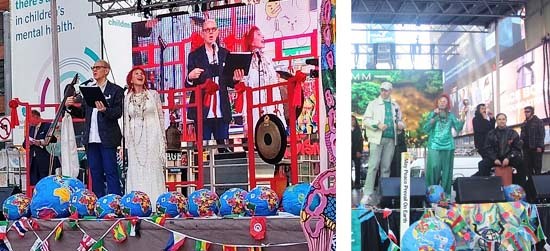
Two concerts at Duffy Square in Times-Square,
New York City, produced and broadcast by Good News Planet
CEO Paul Sladkus |
|
|
 |
|
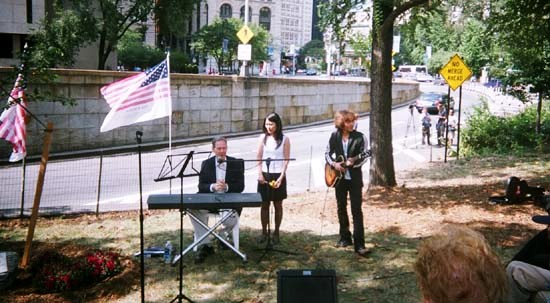
Russell Daisey, Shiang Chen & Shinji Harada
playing
at
Triangle
Park
in downtown
Manhattan on 9/11/2008 |
|
|
|
Considering all this, "Towers of Light"
became a song from which so much light has
shone.
Its verses acknowledge the disorientation of
grief -- the feeling of being broken, the desire to return
to the morning before everything changed, and the struggle
to imagine "normal"
again -
but its chorus transforms the memorial light beams above
Lower Manhattan into a pathway for souls through the image
of light to become a symbol of transcendence and enduring
love.
Over this quarter-century, the song has been
performed on five continents, on over 170 occasions, within
various contexts, and even in a different language. It has
honored the victims of terrorism,
war,
and the holocaust,
comforted
survivors of disasters, and connected people across
national, cultural, and faith boundaries. It
has touched hearts and souls widely -- from a simple
settlement house social to a fancy fundraiser in SONY Hall
for a Buddhist church to a solemn synagogue service on
Holocaust Memorial Day. And, it has appealed to singers of
different backgrounds, ages, ethnicities, and styles, from
classical crossover to pop, folk, and gospel.
As the world marks the 25th anniversary of
September 11, our anthem "Towers
of Light"
continues to carry the heartfelt and healing
purpose with which it was created: to remember those we
lost, to honor those who served and survived, and to affirm
that love can outlast hatred.
Music cannot erase tragedy. But it can give a
voice to sorrow, bring people together, and illuminate a
path toward healing and hope.
When we perform "Towers
of Light", tears often fall but hearts are filled. |
|
|
 |
|
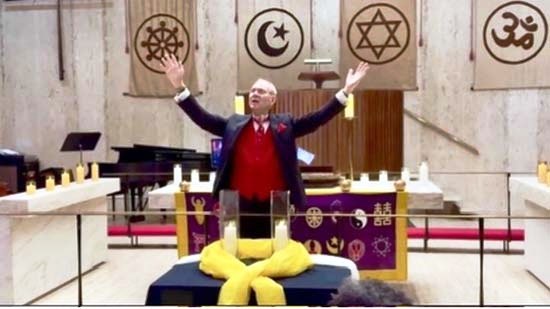
Russell Daisey singing the "Towers
of Light"
song at the Tillman Chapel of the Church
Center for the United Nations on 9/11/2025 with signature
outraised arms signifying hope |
|
|
Lyrics of "Towers
of Light" © 2002
Music by Russell Daisey | Lyrics by Dr. Judy Kuriansky and
Russell Daisey |
|
|
|
Verse 1
I feel like I'm
broken inside me.
I feel that it's
so hard to heal.
There must be a sane way beyond this...
to accept this insanity's
real...
I want to wake up and remember
that morning before it all changed.
But sadly it's
real, not a bad dream.
Our lives have been all rearranged.
Chorus
Towers of Light shine in the night.
A pathway for new stars.
Souls taking flight move to the light...
where they become new stars.
Bridge
They 're
our friends. They're
our lovers.
They 're
our sisters and our brothers.
They 're
our fathers and our mothers taken away
They 're
our husbands. They're
our wives.
They 're
the children in our lives...
and their spirit that survives that fateful
day.
Verse 3
They told us to get back to normal.
But normal's
so far from my mind.
I'm
looking for some kind of closure...
to leave all this sadness behind.
Bridge
But right now let's
honor the heroes...
who sacrificed all for our lives.
There must be a far greater purpose…
where love over hatred survives.
Chorus
Towers of Light shine in the night.
A pathway for new stars.
Souls taking flight move to the light...
where they become new stars.
There they are new stars.
We're
still here,
Gazing at new stars.
New stars.
New stars.
Selected Responses to "Towers
of Light"
"Powerful.
Very powerful." - His Holiness the Dalai Lama
"I
want to play your song before every speech I give."
-Nobel
Peace laureate Betty Williams
"A
beautiful song." _Archbishop Emeritus Desmond Tutu
"A
very heartfelt song." —Radio host Joey Reynolds |
|
|
|
LINKS:
20th Anniversary "Towers
Of Light"
Music video
https://youtu.be/1rEsmrHdshc?feature=shared
TOL performance at the First Hiroshima International Peace
Summit
https://youtu.be/wPDM6LWHI3c
Performance at the Greenwich Connecticut Town Hall
Memorial, 9/11/2005
https://youtu.be/mY2FenYv8vg
TOL Audio MP3: Rena Strober singer, 2006
http://indiemusicpeople.com/songs.aspx?SongID=88563&ArtistID=148662 |
|
|
 |
|
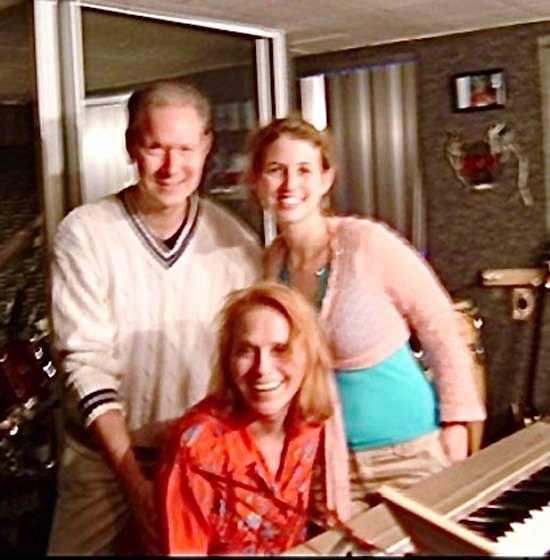
Russell Daisey, Dr. Judy Kuransky, and singer
Rena Strober at one of many
“Towers
of Light”
recording sessions, this one in August 2006 |
|
|
|
Media and Performance Information
Recordings, performance tracks, lyrics and
sheet music are available for media use and live
performance.
Contact:
RussellDaisey@gmail.com |
|
|
|
|

|
Bookmark Dr. Judy's Column on Black Tie International
Magazine
https://blacktiemagazine.com/Judy_Kuriansky/Judy_Kuriansky_Main_page.htm
|
|
|
|
|
| |
|
|
Back To Society News |
|
| |
|